Why is titanium used in orthopedic implants? The answer begins with a practical problem: an implant must survive inside a moving, living body. Titanium offers a strong yet relatively lightweight structure. It can support a damaged hip, knee, spine, or dental component without feeling as heavy as many other metals.
David F. Williams, a respected biomaterials expert, defined biocompatibility this way: “Biocompatibility is the ability of a material to perform with an appropriate host response in a specific situation.” This principle helps explain titanium’s popularity. Its surface forms a stable oxide layer when exposed to oxygen. That layer helps resist corrosion in body fluids. Bone can also grow closely around specially treated titanium surfaces. Surgeons call this process osseointegration.
The material is not perfect. No implant is. Titanium may release particles through wear, especially when paired with other components. Its stiffness also differs from natural bone. This mismatch can sometimes affect how forces travel through the skeleton. Surface roughness, implant design, surgical technique, and patient health all influence outcomes.
Still, titanium provides a useful balance. It combines mechanical strength, corrosion resistance, and biological acceptance. A titanium spinal cage may look small on an operating table. Inside the body, however, it must tolerate years of pressure, movement, and moisture. That long-term demand makes material selection critical.
Understanding why titanium is used in orthopedic implants requires more than praising the metal. It requires examining evidence, limitations, manufacturing quality, and real patient experiences. Titanium is valuable, but careful design remains essential.
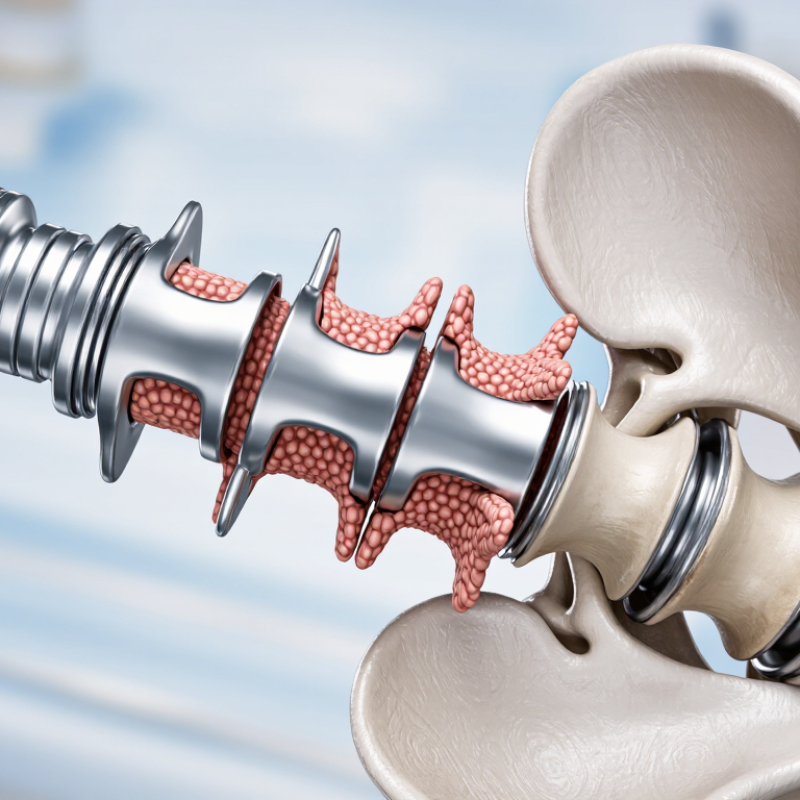
Titanium is used in orthopedic implants because it combines low mass with strong mechanical performance. Its density is about 4.51 g/cm³, according to material data compiled in the ASM Handbook, Volume 2. Stainless steel is heavier, while cobalt-based alloys are denser still. A lighter implant can reduce surgical handling difficulty and limit unnecessary load on surrounding tissue.
The more important figure is stiffness. Titanium’s elastic modulus generally ranges from 105 to 120 GPa, depending on alloy and processing. ASTM F136 data for implant-grade titanium alloy supports this range. Cortical bone is much less stiff, commonly reported near 10–30 GPa in orthopedic literature. This smaller mismatch may reduce stress shielding, where an implant carries excessive load and bone gradually loses density. The comparison is useful, but incomplete.
Porous surfaces can improve bone attachment.
Yet titanium is not mechanically perfect. Its modulus still exceeds bone by several times, and fatigue performance depends on surface finish, geometry, and manufacturing history. A 2022 systematic review in Materials noted that porous and lattice structures may reduce effective stiffness, but their long-term reliability requires careful validation. That warning matters. A laboratory modulus does not predict every patient’s outcome. Surgical technique, bone quality, and cyclic loading can change the real performance substantially. Density and modulus explain titanium’s appeal, but they should never replace patient-specific engineering judgment.
| Material Dimension | Typical Titanium Value or Description | Why It Matters in Orthopedic Implants |
|---|---|---|
| Density | Approximately 4.51 g/cm³ | Lower than stainless steel and cobalt-based alloys, helping reduce implant weight while maintaining structural performance. |
| Elastic Modulus | Approximately 105–120 GPa for commonly used implant-grade titanium alloys | Lower than many steels and cobalt alloys, which can reduce stiffness mismatch with bone and may help limit stress shielding. |
| Cortical Bone Comparison | Cortical bone: approximately 7–30 GPa elastic modulus, depending on direction and measurement method | Titanium is still stiffer than bone, but its modulus is generally closer to bone than that of many conventional metallic alternatives. |
| Yield Strength | Common implant-grade titanium alloys: approximately 800–1,000 MPa, depending on grade and processing | Provides resistance to permanent deformation in plates, screws, stems, cages, and other load-bearing components. |
| Ultimate Tensile Strength | Often approximately 900–1,100 MPa for widely used titanium implant alloys | Supports the high static-load requirements of orthopedic fixation and joint-replacement components. |
| Specific Strength | High strength-to-weight ratio because of its combination of moderate density and high strength | Allows designers to achieve useful mechanical strength without making the implant unnecessarily heavy. |
| Corrosion Resistance | Excellent resistance produced by a stable, self-healing titanium-oxide passive layer | Helps the implant withstand exposure to body fluids and reduces the risk of corrosion-related degradation. |
| Biocompatibility | Generally considered highly biocompatible when appropriately manufactured and finished | The oxide surface is typically well tolerated by tissue and supports long-term implant use. |
| Bone Integration | Supports osseointegration, especially when surface roughness, porosity, and chemistry are appropriately controlled | Promotes mechanical anchoring and direct bone attachment in suitable fixation and reconstruction applications. |
| Fatigue Performance | Good fatigue resistance when geometry, surface finish, residual stress, and manufacturing quality are controlled | Important for implants exposed to repeated walking, lifting, joint motion, or other cyclic loads. |
| Thermal Expansion | Approximately 8.6–9.5 µm/m·K for common titanium grades and alloys | Provides dimensional behavior that must be considered when titanium is used with bone, polymers, ceramics, or dissimilar metals. |
| Melting Temperature | Approximately 1,668°C for commercially pure titanium; alloys melt over composition-dependent ranges | The high melting temperature supports demanding service conditions but requires controlled manufacturing and sterilization processes. |
| Magnetic Behavior | Non-ferromagnetic and generally weakly paramagnetic | Usually creates less magnetic interaction than ferromagnetic materials; MRI safety and image artifacts still require evaluation for the complete implant system. |
| Surface Engineering Potential | Can be machined, grit-blasted, chemically treated, anodized, or additively manufactured with controlled surface features | Enables designers to tailor friction, bone attachment, wear behavior, and fixation performance for different anatomical applications. |
Titanium combines low weight, high strength, and good corrosion resistance. Its density is about 4.51 g/cm³. A lighter implant can ease surgical handling.
Its elastic modulus usually ranges from 105 to 120 GPa. Bone is commonly around 10–30 GPa. The mismatch is smaller than with many heavier metals, but it remains significant.
It may reduce stress shielding because its stiffness is closer to bone. However, titanium is still several times stiffer. Design, geometry, and bone quality also matter.
Some implant-grade alloys have a minimum tensile strength near 900 MPa. This supports loads from walking, lifting, and climbing stairs. Strength alone does not guarantee safety.
Titanium forms a thin oxide layer in body fluids. Proteins and bone-forming cells interact with this surface. Controlled roughness can provide tiny attachment points.
No. Living bone grows closely against the oxide-coated surface. The implant remains metal. The biology is more complicated than that.
Porous structures may lower effective stiffness and improve bone attachment. Small openings can resemble a cellular framework. Long-term reliability still needs careful validation.
Surface finish, manufacturing defects, geometry, heat treatment, and repeated loading can change performance. Healing also depends on blood supply, movement, and bone quality. Results vary.
Not reliably. Laboratory values cannot capture every surgical or biological condition. I may be simplifying the point, but patient-specific judgment remains essential.
Why is titanium used in orthopedic implants? Its combination of low density, high strength, and biological compatibility makes it highly suitable for replacing or supporting damaged bone. With a density of approximately 4.51 g/cm³ and an elastic modulus of about 105–120 GPa, titanium is lighter than many other structural metals while offering mechanical behavior closer to natural bone. Implant-grade materials covered by ASTM F67 and ASTM F136 are designed to meet rigorous requirements for purity, consistency, and clinical performance.
Titanium alloys such as Ti-6Al-4V can provide a minimum tensile strength of around 900 MPa, helping implants withstand demanding loads. Their stable oxide surface also supports osseointegration, allowing bone to attach directly to the implant without an intervening fibrous layer. In addition, titanium offers strong resistance to corrosion in the body. However, its stiffness and density still differ from those of bone, which may affect load transfer and contribute to stress shielding. These trade-offs must be considered when selecting an implant material.

 Weed Orthopedic Implants